Introduce crate crossbeam-circbuf which provides SPSC and SPMC channels based on concurrent
circular buffer. Here is a prototype implementation.
Crossbeam already has a work-stealing deque for being used in task schedulers,
which is successfully deployed in Rayon and
Tokio. However, Tokio actually doesn't use the full functionality of deque,
leaving Deque::pop() unused. This is because Tokio targets on IO and should be fair in executing
tasks, while Deque::pop() will pop the most recent task repeatedly.
Basically, crossbeam-circbuf is the result of removing Deque::pop() from crossbeam-deque.
Since the synchronization between Deque::pop() and Stealer::steal() is the most intricate and
complex part of a work-stealing deque, removing Deque::pop() from the work-stealing deque will
greatly simplify the code base and make it faster.
It is worth noting that Go's scheduler also uses circular buffer, basically.
Besides removing pop(), we renamed existing structs and methods and added a few methods to
circular buffer:
Dequerenamed intoCircBufStealerrenamed intoReceiverDeque::push()renamed intoCircBuf::send()Deque::steal(),Stealer::steal()renamed intoCircBuf::try_recv(),Receiver::try_recv(). Now they returnResult<Some<T>, RecvError>, whereOk(Some(v))means the valuevis returned,Ok(None)means the circular buffer is empty, andErr(RecvError::Retry)means you lost a race and may want to retry.
CircBuf::recv(),Receiver::recv(): retries to receive a value until get a value or check that the circular buffer is empty.Receiver::recv_exclusive(): receives a value, assuming that there are no concurrent receiving methods invocations. It's necessary for providing efficient SPSC receivers.
We provide SPSC and SPMC channels as a thin wrapper around circular buffer. Their API looks like:
use concurrent_circbuf::spsc;
use std::thread;

// Since there's only one receiver, `spsc::new()` just creates it.
let (tx, rx) = spsc::new::<char>();

tx.send('a');
tx.send('b');
tx.send('c');

assert_eq!(rx.recv(), Some('a'));
drop(tx);

thread::spawn(move || {
    assert_eq!(rx.recv(), Some('b'));
    assert_ne!(rx.try_recv(), Ok(None)); // it's not empty
}).join().unwrap();
use concurrent_circbuf::spmc::{Channel, Receiver};
use std::thread;
// Since there can be multiple receivers, `Channel::new()` creates an SPMC channel, and the channel
// can create multiple receivers.
let c = Channel::<char>::new();
let r = c.receiver();
c.send('a');
c.send('b');
c.send('c');
assert_eq!(c.recv(), Some('a'));
drop(c);
thread::spawn(move || {
assert_eq!(r.recv(), Some('b'));
assert_ne!(r.try_recv(), Ok(None)); // Ok(Some('c')) or Err(RecvError::Retry)
}).join().unwrap();We benchmarked the performance of SPSC and SPMC using crossbeam-channel's
benchmark.
Results on an Intel(R) Xeon(R) CPU E5-2620 v3 @ 2.40GHz (12 cores, 24 hw-threads) running Linux 4.11.12-1-MANJARO:
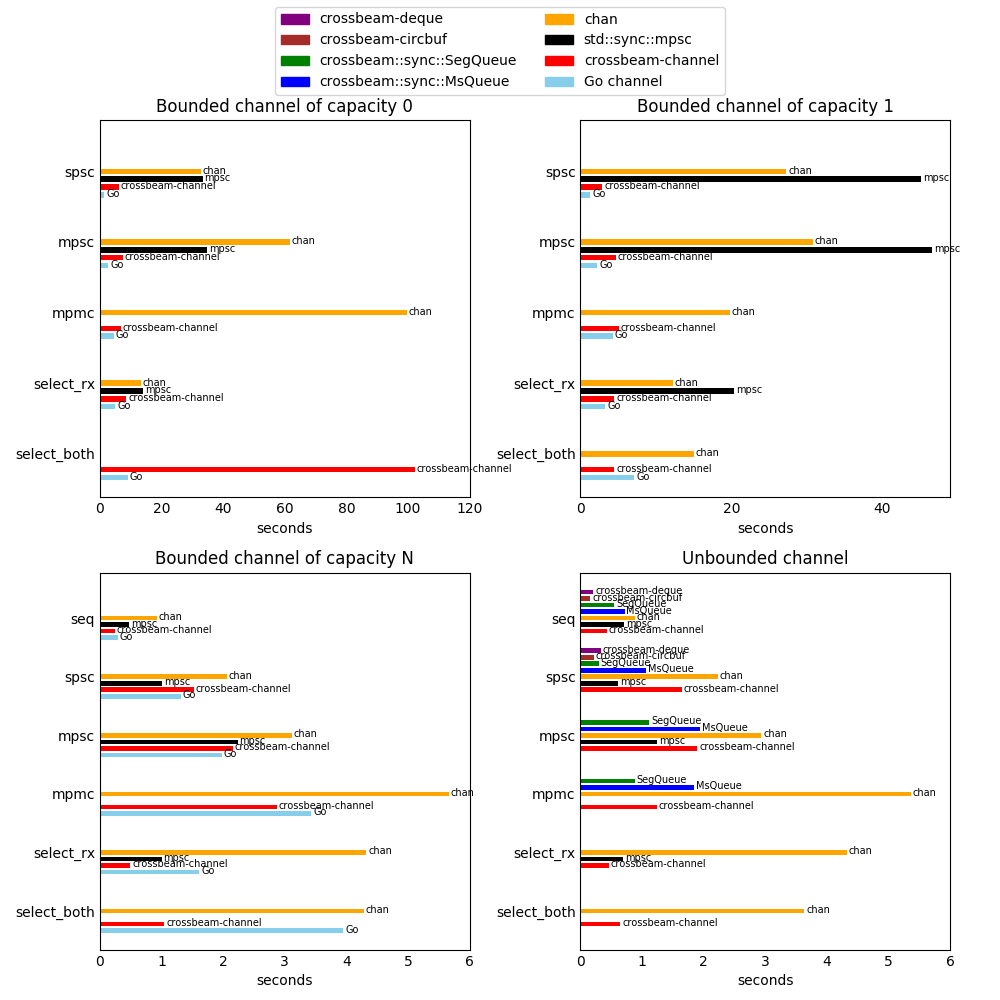
It says crossbeam-circbuf outperforms not only crossbeam-deque but also crossbeam-channel,
crossbeam::sync::SegQueue, and std::sync::mpsc for unbounded SPSC and SPMC scenarios.
We are creating even another crate. Is it worth? Maybe you can use crossbeam-deque in spite of
crossbeam-circbuf's performance advantages.
API distinguishes recv() and try_recv(), the only difference being that recv() always succeeds
in returning value or checking the emptiness, while try_recv() may lose a race and bail out. While
they have different performance characteristics (recv() being ~20% faster than spinning
try_recv() in benchmark), is it actually worth distinguishing?
Not that I'm aware of now.