This repo contains a snapshot of eShopOnWeb as of June 2025.
The purpose of this repo is to show how you can use NServiceBus in .NET apps.
This demo was shown as part of the NimblePros' webinar on domain events.
This repo will be expanded on for the NimblePros' webinar on NServiceBus.
- .NET Aspire eShop sample
- Microsoft also recommends the Reliable Web App patterns guidance for building web apps with enterprise app patterns.
- eShopOnWeb without NServiceBus
We use a workflow_run workflow to add code coverage comments to our PRs. It is a separate workflow detailed in the NimblePros blog post.
Our workflow_run workflow for Commenting on a PR refers to our reusable workflow in NimblePros.GitHub.Workflows. This is why there are 2 jobs in this workflow:
- A job to capture the variables from the calling workflow
- A job to call to the reusable workflow. This has to be in its own job and cannot be a step in a job.
- Meet our Particular Software Recognized Professionals
- NimblePros Named a Particular Partner for Expertise in NServiceBus
- NimblePros Blog Series on NServiceBus including:
- Introduction and Getting Started
- Concepts such as asychronous messaging and commands, events, and messages
- Testing Message Handlers
- Sagas - Introduction, create your first saga, timeout tips, and testing strategies
- And some fun! Automating Santa's Workshop with NServiceBus
A list of Frequently Asked Questions about this repository can be found here.
- Overview Video
- eBook
- Topics (eBook TOC)
- Running the sample using Azd template
- Running the sample locally
- Dev Containers for the eShopOnWeb repo
- Running the sample using Docker
- Getting the GitHub Single Sign-On Working
- Community Extensions
Steve "ardalis" Smith recorded a live stream providing an overview of the eShopOnWeb reference app in October 2020.
Note: NServiceBus is not mentioned in the eBook. This repo has a custom vendor implementation that differs from what is in the book.
This reference application is meant to support the free .PDF download ebook: Architecting Modern Web Applications with ASP.NET Core and Azure, updated to ASP.NET Core 8.0. Also available in ePub/mobi formats.
You can also read the book in online pages at the .NET docs here: https://docs.microsoft.com/dotnet/architecture/modern-web-apps-azure/

The eShopOnWeb sample is related to the eShopOnContainers sample application which, in that case, focuses on a microservices/containers-based application architecture. However, eShopOnWeb is much simpler in regards to its current functionality and focuses on traditional Web Application Development with a single deployment.
The goal for this sample is to demonstrate some of the principles and patterns described in the eBook. It is not meant to be an eCommerce reference application, and as such it does not implement many features that would be obvious and/or essential to a real eCommerce application.
- Introduction
- Characteristics of Modern Web Applications
- Choosing Between Traditional Web Apps and SPAs
- Architectural Principles
- Common Web Application Architectures
- Common Client Side Technologies
- Developing ASP.NET Core MVC Apps
- Working with Data in ASP.NET Core Apps
- Testing ASP.NET Core MVC Apps
- Development Process for Azure-Hosted ASP.NET Core Apps
- Azure Hosting Recommendations for ASP.NET Core Web Apps
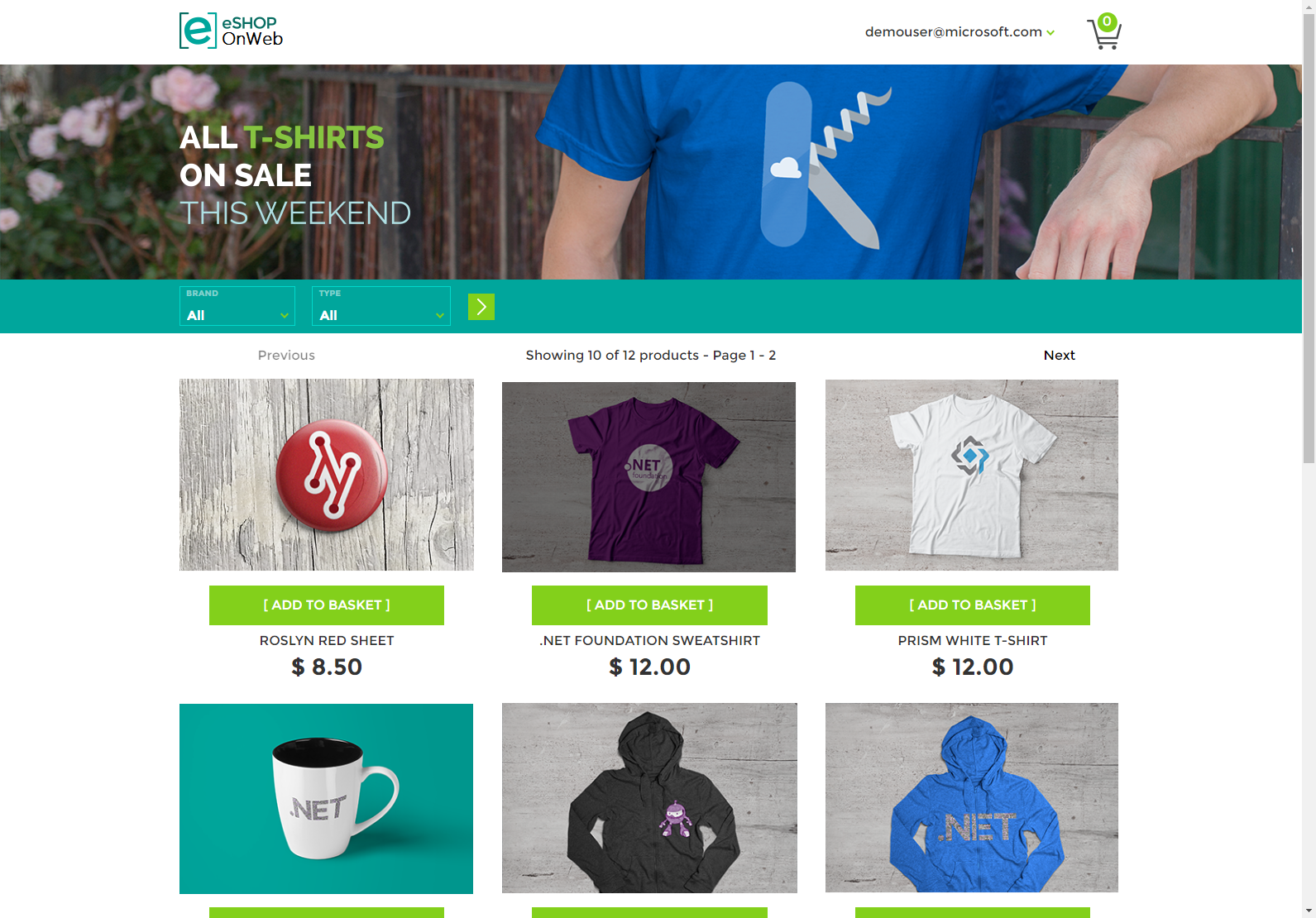
The store's home page should look like this:
The Azure Developer CLI (azd) is a developer-centric command-line interface (CLI) tool for creating Azure applications.
You need to install it before running and deploying with Azure Developer CLI.
powershell -ex AllSigned -c "Invoke-RestMethod 'https://aka.ms/install-azd.ps1' | Invoke-Expression"curl -fsSL https://aka.ms/install-azd.sh | bash
And you can also install with package managers, like winget, choco, and brew. For more details, you can follow the documentation: https://aka.ms/azure-dev/install.
After logging in with the following command, you will be able to use the azd cli to quickly provision and deploy the application.
azd auth login
Then, execute the azd init command to initialize the environment.
azd init -t NimblePros/eShopOnWeb
Run azd up to provision all the resources to Azure and deploy the code to those resources.
azd up
According to the prompt, enter an env name, and select subscription and location, these are the necessary parameters when you create resources. Wait a moment for the resource deployment to complete, click the web endpoint and you will see the home page.
Notes:
- Considering security, we store its related data (id, password) in the Azure Key Vault when we create the database, and obtain it from the Key Vault when we use it. This is different from directly deploying applications locally.
- The resource group name created in azure portal will be rg-{env name}.
You can also run the sample directly locally (See below).
Most of the site's functionality works with just the web application running. However, the site's Admin page relies on Blazor WebAssembly running in the browser, and it must communicate with the server using the site's PublicApi web application. You'll need to also run this project. You can configure Visual Studio to start multiple projects, or just go to the PublicApi folder in a terminal window and run dotnet run from there. After that from the Web folder you should run dotnet run --launch-profile https. Now you should be able to browse to https://localhost:5001/. The admin part in Blazor is accessible to https://localhost:5001/admin
Note that if you use this approach, you'll need to stop the application manually in order to build the solution (otherwise you'll get file locking errors).
After cloning or downloading the sample you must setup your database. To use the sample with a persistent database, you will need to run its Entity Framework Core migrations before you will be able to run the app.
You can also run the samples in Docker (see below).
-
By default, the project uses a real database. If you want an in memory database, you can add in the
appsettings.jsonfile in the Web folder{ "UseOnlyInMemoryDatabase": true } -
Ensure your connection strings in
appsettings.jsonpoint to a local SQL Server instance. -
Ensure the tool EF was already installed. You can find some help here
dotnet tool update --global dotnet-ef -
Open a command prompt in the Web folder and execute the following commands:
dotnet restore
dotnet tool restore
dotnet ef database update -c catalogcontext -p ../Infrastructure/Infrastructure.csproj -s Web.csproj
dotnet ef database update -c appidentitydbcontext -p ../Infrastructure/Infrastructure.csproj -s Web.csproj
These commands will create two separate databases, one for the store's catalog data and shopping cart information, and one for the app's user credentials and identity data.
-
Run the application.
The first time you run the application, it will seed both databases with data such that you should see products in the store, and you should be able to log in using the [email protected] account.
Note: If you need to create migrations, you can use these commands:
-- create migration (from Web folder CLI)
dotnet ef migrations add InitialModel --context catalogcontext -p ../Infrastructure/Infrastructure.csproj -s Web.csproj -o Data/Migrations

dotnet ef migrations add InitialIdentityModel --context appidentitydbcontext -p ../Infrastructure/Infrastructure.csproj -s Web.csproj -o Identity/Migrations
We use dev containers to make it easier for you to run the eShopOnWeb application locally as well as our documentation.
This project includes a .devcontainer folder with a dev container configuration, which lets you use a container as a full-featured dev environment.
You can use the dev container to build and run the app without needing to install any of its tools locally. You can work in GitHub Codespaces or the VS Code Dev Containers extension!
Learn more about using the dev container in eShopOnWeb's dev container readme.
If you want to help maintain the documentation, we have a .devcontainer folder within the docs folder. This allows us to see our documentation changes in a container running Ruby and the GitHub Pages environment.
- NimblePros YouTube: Run GitHub Pages Locally in a Dev Container
- NimblePros Blog: Run GitHub Pages Locally in a Dev Container
- NimblePros Blog: Introduction to Dev Containers
- NimblePros Webinar: Dev Containers Unwrapped!
You can run the Web sample by running these commands from the root folder (where the .sln file is located):
docker-compose build
docker-compose up
You should be able to make requests to localhost:5106 for the Web project, and localhost:5200 for the Public API project once these commands complete. If you have any problems, especially with login, try from a new guest or incognito browser instance.
You can also run the applications by using the instructions located in their Dockerfile file in the root of each project. Again, run these commands from the root of the solution (where the .sln file is located).
We include GitHub as our external provider for single sign-on.
To get it running locally, you'll want to register an application in GitHub and store values in user secrets for the client ID and client secret.
We explain the code in detail in our course on ASP.NET Identity in Action: Implementing Individual Accounts.
We have some great contributions from the community, and while these aren't maintained by Microsoft we still want to highlight them.
eShopOnWeb VB.NET by Mohammad Hamdy Ghanem
FShopOnWeb An F# take on eShopOnWeb by Sean G. Wright and Kyle McMaster