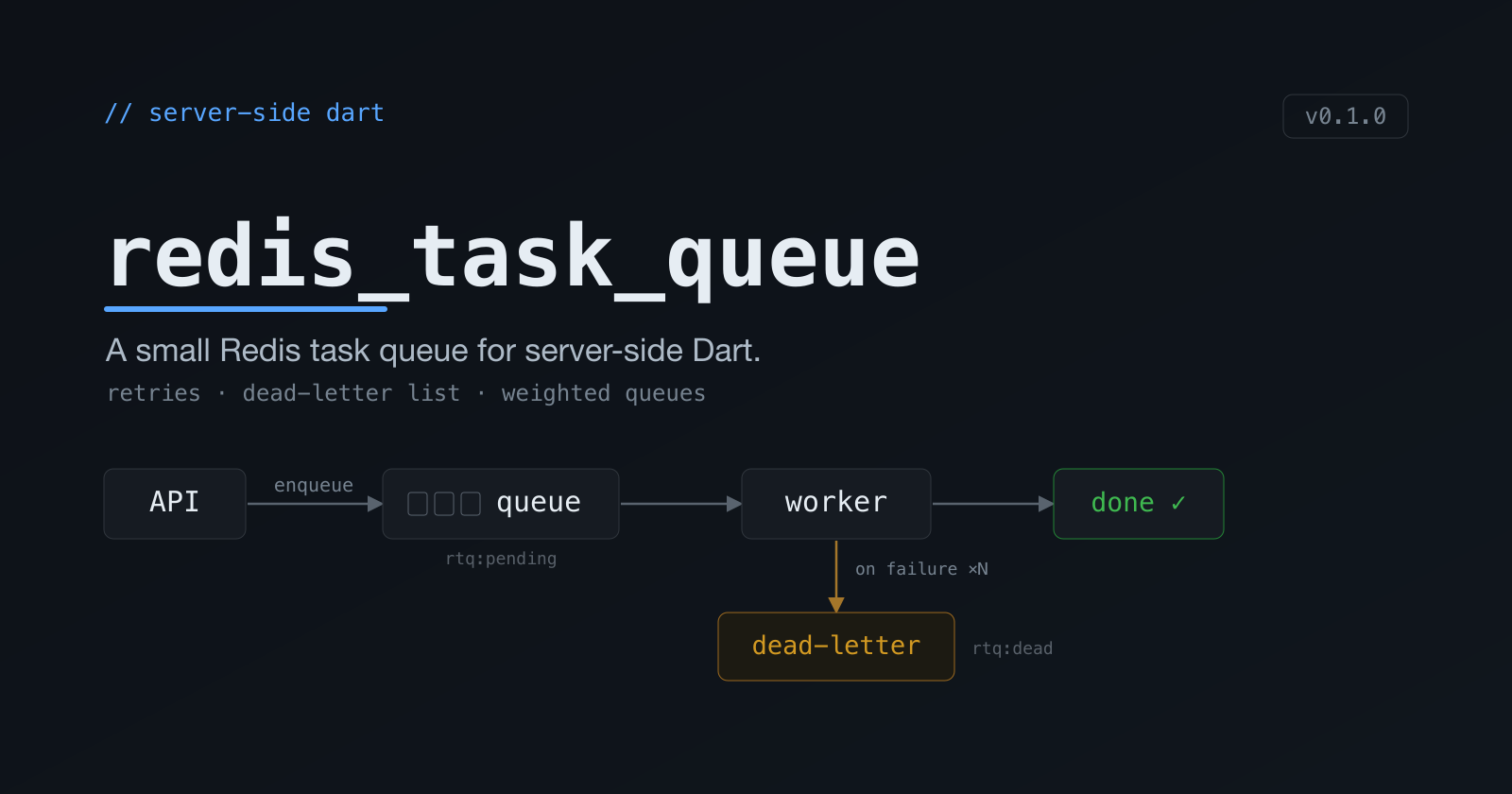
A small Redis-backed task queue for server-side Dart. Enqueue work from your request path and process it in a separate worker — with retries, a dead-letter list, weighted queues so one noisy queue can't starve the others, and crash-safe at-least-once delivery: a task a worker was running when it died is recovered on restart, not lost.
If you've used Asynq in Go or Sidekiq in Ruby, the model will feel familiar. Dart server frameworks (Serverpod, Dart Frog, Shelf) don't have a maintained equivalent, so this fills that gap with a deliberately small surface.
The path a task takes, end to end:

Background: I wrote up the design decisions behind this — porting the Asynq model to Dart, and what I left out — on my blog.
Anything slow or retryable — sending email, processing an upload, calling a flaky third-party API — shouldn't run inside the request. It should go on a queue and be handled out of band, where a failure can be retried instead of turning into a 500 the user sees.
That's all this does: a producer drops a task onto Redis and returns immediately; a worker picks it up, runs it, and retries on failure until it either succeeds or lands in the dead-letter list.
dart pub add redis_task_queuefinal client = await QueueClient.connect(); // localhost:6379 by default
await client.enqueue(
Task('email:welcome', {'user_id': '42'}),
queue: 'default',
maxRetries: 5,
);enqueue is a single LPUSH — keep one client around and reuse it.
enqueue can also hold a task until a future time. Pass processIn (a delay
from now) or processAt (an absolute time) — one or the other, not both:
// Run in roughly 15 minutes.
await client.enqueue(
  Task('email:reminder', {'user_id': '42'}),
  processIn: const Duration(minutes: 15),
);

// Run at (or promptly after) a specific moment.
await client.enqueue(
  Task('report:daily', {}),
  processAt: DateTime(2026, 7, 11, 6),
);
There is no new machinery behind this: a scheduled task goes into the same
per-queue delayed sorted set the retry backoff uses, scored with its due time,
and the same due-mover promotes it. Two caveats follow from that. The task
starts up to about a second past its due time, plus however long the task the
worker is currently handling takes (the mover runs once per poll-loop pass),
and it only starts while a worker polling that queue is running — with no
worker up, it just waits in the set. A processAt in the past runs promptly
on the next mover pass.
final worker = await Worker.connect(
  // Required. Stable across this worker's restarts, and different from every
  // other worker's — see "Recovery and worker ids" below.
  workerId: Platform.environment['POD_NAME'] ?? 'worker-1',
  queues: {'critical': 6, 'default': 3, 'low': 1},
  // Optional — these are the defaults. The first retry waits backoffBase,
  // each further retry doubles it up to backoffCap, plus a bit of jitter.
  backoffBase: const Duration(seconds: 1),
  backoffCap: const Duration(seconds: 60),
  backoffJitter: 0.1, // 0..1; fraction of the delay added at random
);

worker.handle('email:welcome', (task, context) async {
  // Real work. Throwing triggers a retry; returning marks the task done.
  //
  // `context` describes this run: `context.id` is the task's id, the same on
  // every attempt and after a crash recovery, so it is what to record against
  // the effect. `context.attempt`, `context.maxAttempts` and
  // `context.isLastAttempt` say where in the retry budget this run sits.
  await sendWelcomeEmail(task.payload['user_id'] as String);
});

await worker.run();
To shut down gracefully, on a SIGTERM or a rolling deploy, await stop(): it
stops claiming new tasks and returns once the task in progress has finished, so
work is drained rather than abandoned to recovery on the next start.
await worker.stop();
await worker.close();A task moves through a small set of states — it either lands on done or, once
retries are exhausted, on the dead-letter list:

- Weighted queues. With
{'critical': 6, 'default': 3, 'low': 1}the worker givescriticalfirst look six times as often aslow(a rotating cursor over the weighted order), so under load the queues are served roughly 6:3:1. A flood of low-priority jobs can't starve important ones — and, unlike strict priority, a flood of critical jobs can't fully starveloweither, since it still leads one sweep in every ten. - Retries with exponential backoff. A handler that throws is retried up to
the task's
maxRetries. Retries aren't immediate: the envelope goes into a per-queue delayed sorted set (<prefix>:queue:<queue>:delayed) scored with the time it becomes due. The wait growsmin(cap, base * 2^(retry-1))— the first retry waitsbackoffBase(default 1s), each further one doubles up tobackoffCap(default 60s) — plus a little jitter so a burst of failures doesn't re-fire in lockstep. All three are configurable onWorker.connect. - Crash-safe at-least-once delivery. The worker claims a task by atomically
moving it (
LMOVE) from its pending list onto a per-worker in-flight list, and only removes it from there once the task is done, retried, or dead-lettered — each of those transitions is a single Lua step, so the task is never off both lists at once. If the worker process dies mid-task (a crash, an OOM kill, a lost node), the envelope stays on the in-flight list; on its nextrunthe worker requeues everything left on its own list and runs it again. Nothing is silently lost. The trade is that a task can run more than once (it crashed after finishing but before the removal), so handlers must be idempotent — the same contract as Sidekiq or Asynq. The handler is given what it needs to hold up its end:context.idis assigned at enqueue and is identical on every attempt and every recovery, so it is the key to write against the effect.example/at_least_once.dartstages the crash and counts the result, with and without that defence. - Reconnects after a dropped connection. Neither a
Workernor aQueueClientbreaks permanently when the connection to Redis drops (a restart, a managed-Redis failover, a proxy's idle timeout): every Redis call in both classes retries once through a fresh connection before giving up. ForQueueClient, a call whose retry also fails still throws — Redis is genuinely down, not just blipped, and the caller needs to know that. ForWorker.run(), that same failure doesn't end the loop: it backs off, reconnects, reruns orphan recovery, and keeps polling, so a dropped connection costs a delay, not the worker. - Due-mover. Each poll-loop pass, before it claims the next task, the worker
promotes any delayed tasks whose score has passed back onto their pending
list. The move runs inside a single Redis Lua script (
ZRANGEBYSCORE+ZREM+LPUSH), so it's atomic — a task can't be lost or duplicated, even if several workers run the mover at once. Claims use a short (1s) blocking wait, so a due task waits at most about a second past its scheduled time. - Dead-letter list. Once retries are exhausted, the task moves to a
dead-letter list (
<prefix>:dead) instead of looping forever, stored with the error that gave up on it.QueueClientreads and manages it:deadLetters()returns the entries (each aDeadLetterwith the task, the queue, the error text, the attempt count, and when it died),replayDeadLetter(id)re-enqueues one onto its queue for a fresh set of attempts once you have fixed the cause, andpurgeDeadLetters()clears them out. Nothing drains the list for you, so a queue nobody reads is an outage nobody hears about. - Missing handler = failure. A task with no registered handler is retried, not silently dropped, so a wiring mistake surfaces loudly.
for (final dead in await client.deadLetters()) {
  print('${dead.task.type} ${dead.id} failed: ${dead.error}');
}

// After fixing what broke, send one back for another try:
await client.replayDeadLetter(deadId);

// Or clear entries that are not worth replaying:
await client.purgeDeadLetters();
A replay removes the entry and re-enqueues the task in one atomic step, so it can't be dropped from the dead-letter list without landing back on its queue, or enqueued twice if two callers replay it at once.
final stats = await client.stats();
print('pending ${stats.totalPending}, in flight ${stats.inFlight}, '
    'delayed ${stats.totalDelayed}, dead ${stats.deadLetter}');
print(stats.pending); // {critical: 0, default: 128, low: 12}
stats() reads counters, not tasks, so it is cheap enough to poll for a
dashboard or a backlog alert: a pending count that only climbs means the workers
are behind, and a dead-letter count that climbs means something is failing for
good. It discovers the active queues with a SCAN (never KEYS, so it does not
block Redis). Pass queues: [...] to count exactly those instead, which also
reports a queue that has no keys yet as zero rather than omitting it.
In-flight recovery keys off workerId, which is required and has to be two
things at once:
- Stable across restarts. A restarted worker reclaims whatever is left on its own in-flight list. An id that changes every start — a pid, a fresh UUID — strands those envelopes on a list nobody reads again, losing the tasks.
- Different from every other worker's. Recovery cannot tell a dead worker's leftovers from a live worker's current task, so two workers sharing an id each requeue the other's in-flight work at startup and run it a second time.
A StatefulSet pod name, a service name, or a host name plus a slot number all
satisfy both. There is deliberately no default: the obvious one (the host name)
is silently wrong the moment a second worker starts on the same machine, and
picking it for you would hide that. Passing the same id to two workers in one
isolate throws a StateError; across processes nothing can detect it, so choose
ids that cannot collide.
The one case this doesn't cover on its own: a worker that dies and is never
restarted with the same id (an ephemeral pod that comes back under a fresh
name). Its in-flight list has no owner to reclaim it. If your deployment can do
that, run workers under stable ids, or have a supervisor requeue any
<prefix>:inflight:* list belonging to an id that is no longer running.
Everything this package throws for a Redis failure is a TaskQueueException,
so one catch clause covers the lot:
try {
  await client.enqueue(Task('email:welcome', {'to': address}));
} on TaskQueueConnectionException {
  // Redis is unreachable — the call already retried once on a fresh socket.
  // Shed the request or buffer it; do not assume the task was queued.
} on TaskQueueServerException {
  // Redis answered with an error. Sending the same command again will get the
  // same refusal, so this is a bug or an operational limit, not a blip.
}
It is sealed, so those two subtypes are the whole set and a switch over
them stays exhaustive. The wrapper exists because the raw errors are not usable
as a contract: package:redis raises RedisError, RedisRuntimeError and
TransactionError, none of which implement Exception (so on Exception catch
misses them), and a dropped socket arrives variously as a SocketException, a
StateError, or a bare String. The original is kept on .cause for logging.
- No recurring schedules (cron), no unique-task dedup, no web UI. One-shot
scheduling (
processAt/processIn) shipped in 0.3.0; recurring schedules are still out. The goal is the enqueue → process → backoff-retry → dead-letter core, done clearly.
- Dart 3.5+
- A running Redis instance
# terminal 1
dart run example/redis_task_queue_example.dart worker
# terminal 2
dart run example/redis_task_queue_example.dart enqueueThe tests talk to a real Redis rather than a fake, so they need one listening on
port 6399. That is what CI does: it runs a redis:7 container with the
container's 6379 published on 6399, then dart test with no arguments.
docker run --rm -p 6399:6379 redis:7
dart test
The port is deliberately not 6379 so a test run cannot touch a Redis you are already using. The tests create and delete keys under their own prefixes.
MIT © Yusuf İhsan Görgel