Summary
The nginx-ui application is vulnerable to a Race Condition. Due to the complete absence of synchronization mechanisms (Mutex) and non-atomic file writes, concurrent requests lead to the severe corruption of the primary configuration file (app.ini). This vulnerability results in a persistent Denial of Service (DoS) and introduces a non-deterministic path for Remote Code Execution (RCE) through configuration cross-contamination.
Details
The vulnerability exists because the settings update pipeline does not implement any synchronization primitives. When multiple requests reach the handler simultaneously:
- Memory Corruption:
ProtectedFill() modifies shared global singleton pointers without thread-safety, leading to inconsistent states in memory.
- File Corruption: The underlying library (
gopkg.in/ini.v1) performs direct overwrites. Concurrent write operations interleave at the OS level, resulting in app.ini files with empty leading lines, truncated fields, or partially overwritten configuration keys.
- State Persistent Failure: Depending on which bytes are corrupted, the application either fails its "is-installed" check (redirecting to
/install) or encounters a fatal error during boot/runtime that prevents the process from responding to any further requests.
Environment:
- OS: Kali Linux 6.17.10-1kali1 (6.17.10+kali-amd64)
- Application Version: nginx-ui v2.3.3 (513) e5da6dd (go1.26.0)
- Deployment: Docker Container
PoC
- Check original app.ini file valid state:

- Log in to the
nginx-ui dashboard.
- Navigate to Preferences and update settings. Capture a
POST /api/settings request and send it to Burp Suite Intruder.
- Configure the attack with Null payloads (to test basic concurrency) or a Fuzzing list (to test data-driven corruption).
- Set the Resource Pool to 20-50 concurrent requests.

- Observation (In-flight corruption): Monitor the
app.ini file. You will observe the file being written with empty leading lines or incomplete key-value pairs.
- Observation (Recovery Failure): If the service redirects to
/install, attempting to complete the setup again often fails because the underlying configuration state is too corrupted to be reconciled by the installer logic.
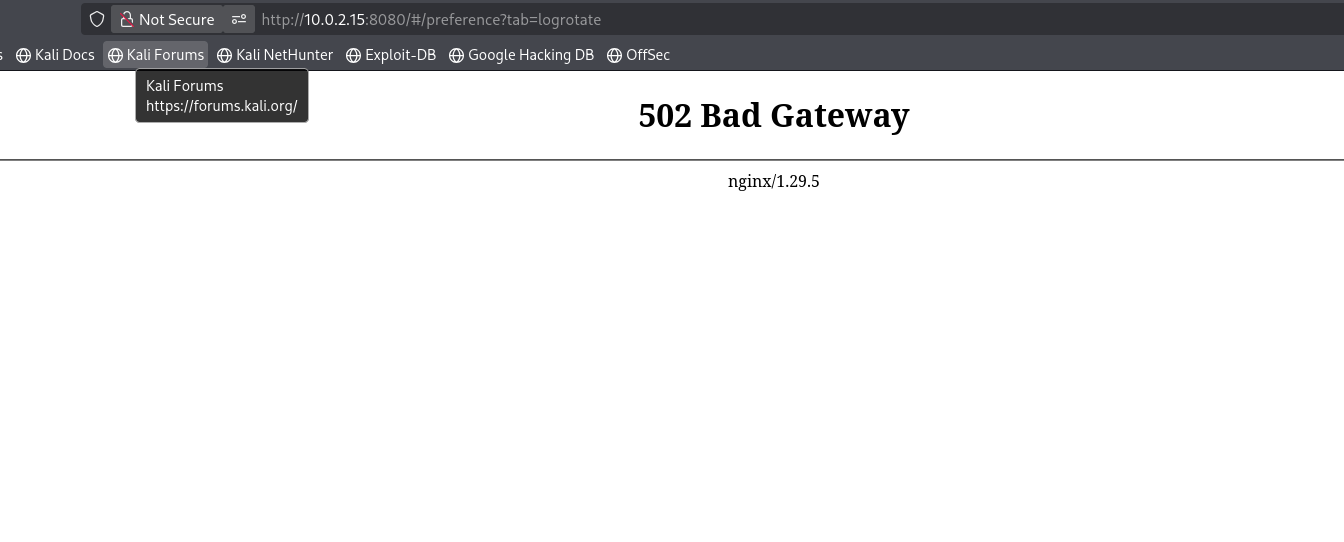
- Observation (Total Service Collapse): When the corruption in
app.ini becomes so severe, the Go runtime or the INI parser encounters a fatal error, causing the Nginx-UI service to stop responding entirely (Hard DoS).
-
Observation (Cross-Section Contamination): During testing, it was observed that sometimes INI sections become interleaved. For example, fields belonging to the [nginx] section (like ConfigDir or ReloadCmd) were erroneously written under the [webauthn] section.
Example of corrupted output observed:
[webauthn]
RPDisplayName  =
RPID           =
RPOrigins      =
gDirWhiteList  =
ConfigDir      = /etc/nginx
ConfigPath     =
PIDPath        = /run/nginx.pid
SbinPath       =
TestConfigCmd  =
ReloadCmd      = nginx -s reload
RestartCmd     = nginx -s stop
StubStatusPort = 51820
ContainerName  =
Impact
This is a High security risk (CWE-362: Race Condition).
- Integrity: Permanent corruption of application settings and system-level configuration.
- Availability: High. The attack results in a persistent Denial of Service that cannot be recovered via the web UI.
- Remote Code Execution (RCE) Risk: Since the application allows updating certain fields (like Node Name) and uses others as shell commands (like ReloadCmd or RestartCmd), the observed "cross-contamination" of INI values means an attacker could potentially force a user-controlled string into a command execution field. If ReloadCmd is overwritten with a malicious payload provided in another field, the next nginx reload will execute that payload. While highly impactful, this specific exploit path is non-deterministic and depends on the precise interleaving of thread execution, making targeted exploitation difficult.
Recommended Mitigation
- Implement Mutex Locking: Wrap the
ProtectedFill and settings.Save() calls in a sync.Mutex to serialize access to global settings.
- Atomic File Writes: Implement a "write-then-rename" strategy. Write the new configuration to
app.ini.tmp and use os.Rename() to replace the original file atomically, ensuring the configuration file is always in a valid state.
A patched version of nginx-ui is available at https://github.com/0xJacky/nginx-ui/releases/tag/v2.3.4.
References

dapickle Reporter
Summary
The
nginx-uiapplication is vulnerable to a Race Condition. Due to the complete absence of synchronization mechanisms (Mutex) and non-atomic file writes, concurrent requests lead to the severe corruption of the primary configuration file (app.ini). This vulnerability results in a persistent Denial of Service (DoS) and introduces a non-deterministic path for Remote Code Execution (RCE) through configuration cross-contamination.Details
The vulnerability exists because the settings update pipeline does not implement any synchronization primitives. When multiple requests reach the handler simultaneously:
ProtectedFill()modifies shared global singleton pointers without thread-safety, leading to inconsistent states in memory.gopkg.in/ini.v1) performs direct overwrites. Concurrent write operations interleave at the OS level, resulting inapp.inifiles with empty leading lines, truncated fields, or partially overwritten configuration keys./install) or encounters a fatal error during boot/runtime that prevents the process from responding to any further requests.Environment:
PoC
nginx-uidashboard.POST /api/settingsrequest and send it to Burp Suite Intruder.app.inifile. You will observe the file being written with empty leading lines or incomplete key-value pairs./install, attempting to complete the setup again often fails because the underlying configuration state is too corrupted to be reconciled by the installer logic.app.inibecomes so severe, the Go runtime or the INI parser encounters a fatal error, causing the Nginx-UI service to stop responding entirely (Hard DoS).Observation (Cross-Section Contamination): During testing, it was observed that sometimes INI sections become interleaved. For example, fields belonging to the
[nginx]section (likeConfigDirorReloadCmd) were erroneously written under the[webauthn]section.Example of corrupted output observed:
Impact
This is a High security risk (CWE-362: Race Condition).
Recommended Mitigation
ProtectedFillandsettings.Save()calls in async.Mutexto serialize access to global settings.app.ini.tmpand useos.Rename()to replace the original file atomically, ensuring the configuration file is always in a valid state.A patched version of nginx-ui is available at https://github.com/0xJacky/nginx-ui/releases/tag/v2.3.4.
References